Commentary
HB 270 isn't a train. It's permission to build one.
A new bill wants high-speed rail on I-35 from Dallas to San Antonio. It has no route, no price and no builder. What it does have is the one change Texas rail has needed since 2017: it lets the state help.
- Sections in HB 270
- 2
- Amtrak, Dallas to Austin today
- 6h 44m
- Legislature convenes
- Jan 12
I’m a car guy. I like driving. I also hate sitting on I-35, and anyone who has driven from Dallas to Austin or San Antonio on a Friday afternoon knows exactly what I mean.
So when State Rep. John Bucy filed HB 270 on November 9 for high-speed rail between Dallas and San Antonio, I read it. All of it. That didn’t take long.
What the bill actually says
HB 270 has two working parts.
The first tells TxDOT it “shall enter into a comprehensive development agreement with a private entity” to build, maintain and operate high-speed rail from Dallas to Waco to Austin to San Antonio along the I-35 corridor. The bill defines high-speed as 110 mph or faster.
The second repeals Section 199.003 of the Transportation Code, the 2017 law that keeps the state from spending money on high-speed rail run by a private company.
That’s it. No price tag. No route map. No named builder. No timeline, no funding source, no ridership study. It takes effect September 1, 2027 if it passes. It hasn’t been sent to a committee yet (bill history).
So is this a real proposal? Not in the sense of a project somebody is ready to build. Nobody has a Dallas to San Antonio line in the works. This is a bill to get the state involved, and that’s fine, because getting the state involved is exactly the problem Texas rail has had for a decade.
It isn’t a fringe idea either. The same bill last session, HB 483, got out of a Republican-chaired House Transportation Committee 8-4 in May 2025 (committee minutes). Chairman Tom Craddick’s version added the Waco stop. Then it died without a floor vote.
TxDOT has already studied this corridor, too. Its 2017 Texas-Oklahoma Passenger Rail Study picked electric high-speed rail as the preferred option from Dallas and Fort Worth to San Antonio. It called for 12 to 20 round trips a day and a trip of about two hours. That study has been sitting on a shelf for nine years.
The repeal is the real story
I went back and forth on X plenty when Dallas to Houston was the fight. I liked that proposal for the most part. Texas Central was trying to get most of it done with private money, and that’s how I’d want it done.
Here’s what happened. Texas Central pitched the line in 2009: Japanese bullet train technology, about 90 minutes between the two biggest metros in the state. It raised private money. In June 2022 the Texas Supreme Court ruled it could use eminent domain.
By then its board had broken up and its CEO had resigned, and land buying had all but stopped (Texas Tribune). Amtrak came in as a partner and won a $63.9 million federal planning grant. In April 2025 USDOT canceled it. Secretary Sean Duffy said “if the private sector believes this project is feasible, they should carry the pre-construction work forward.” By then the cost estimate had gone from $12 billion to more than $30 billion, and USDOT put it past $40 billion. The company had about 25% of the parcels it needed (Texas Tribune).
It’s still not dead. A Fort Worth investor now leads it, and the old Northwest Mall, the site picked for its Houston station, is being torn down. But it’s still stalled, and the region’s top transportation planner, NCTCOG’s Michael Morris, says we’ll know within about 18 months whether it ever gets built (KPRC).
Look at the trap. Washington says let the private sector do it. Section 199.003 says the State of Texas can’t help the private sector do it. Meanwhile the project has to take land from landowners, cross public roads and use public right-of-way.
It’s hard to be 100% private when you’re dealing with eminent domain, public land and public use. Highways aren’t private. Airports aren’t private. Pretending a train has to be is how you get 17 years of PowerPoints.
Start smaller if we have to, but not Amtrak-small
I’d prefer bullet-train speed. Honestly, I’ll take what I can get.
A YouTuber named Lucid Stew did a video, Replacing Interstate 45 with High Speed Rail, that lays a line down I-45 itself and compares it to Texas Central’s planned route. The freeway is full of curves, so the train has to slow to around 110 to 125 mph through the metros. Texas Central gave the same reason for not following I-45: the highway was built for cars, not 200 mph trains. The slower version doesn’t beat driving by nearly as much.
I’d still take it. Anything that starts and proves it’s worth going bigger works for me.
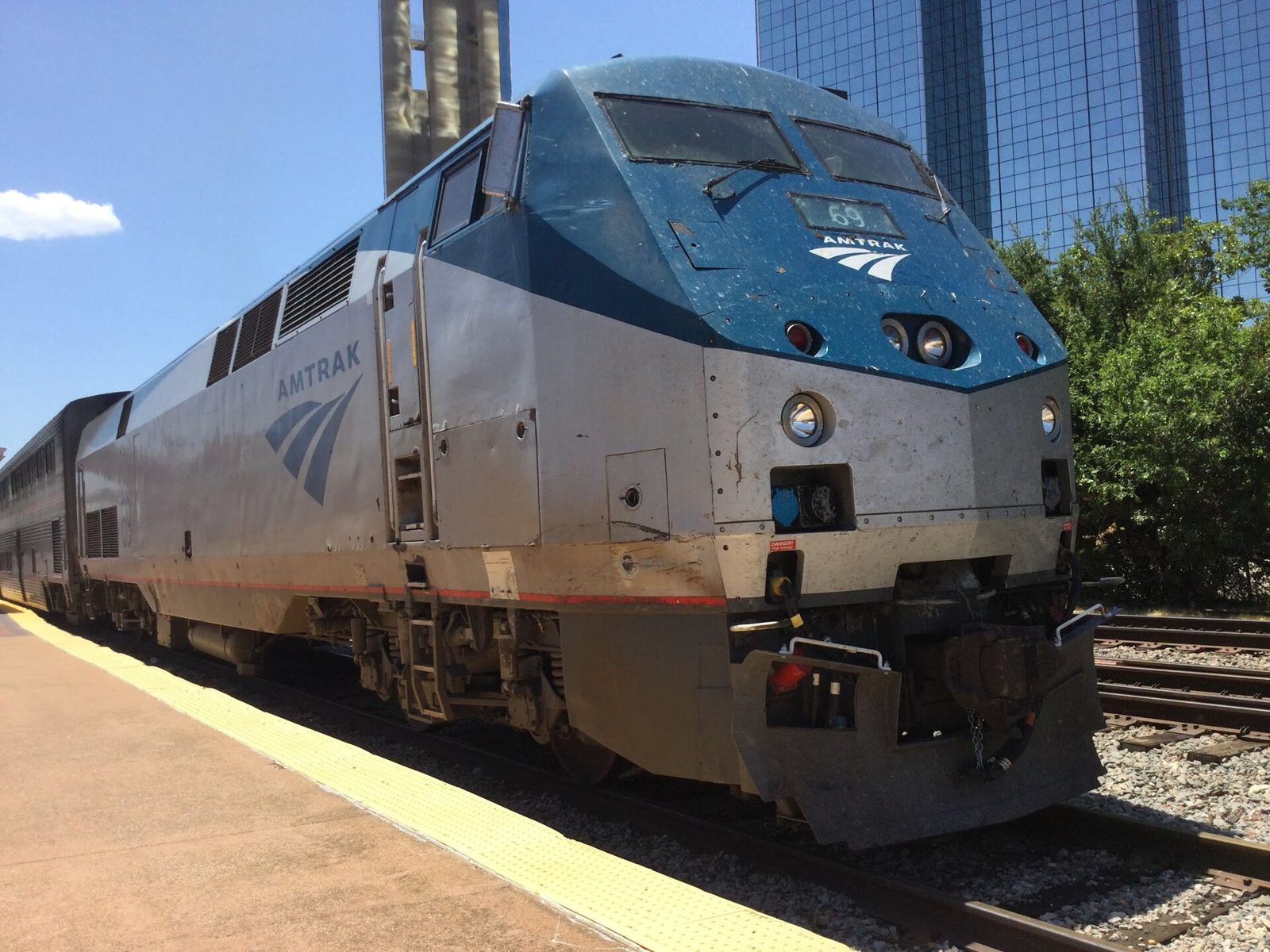
The catch is that it can’t be bad. Right now the Amtrak Texas Eagle is the train between Dallas and Austin. It runs once a day. It leaves Dallas at 12:38 pm, gets to Austin at 7:22 pm and San Antonio at 10:46 pm. That’s six hours and 44 minutes to Austin, a trip you can drive in about half that. It shares its tracks with freight trains, so it waits on freight.
If the first Texas line looks like that, it’ll be a joke, and it’ll make the whole idea look bad for another 20 years. Whatever speed we start at, it needs its own track and enough trains a day that people can plan around it.
Give landowners a stake, not just a check
It’s always harder to take someone’s land, especially in Texas. That’s a big part of why Texas Central stalled.
We already know how to do this here. An oil company doesn’t buy the minerals under a ranch. It leases them, pays the owner a bonus to sign, and then pays a royalty, a cut of everything the well produces. The old standard was one-eighth, and today it’s closer to 20 to 25 percent (Texas Real Estate Research Center). Plenty of Texas families built generational wealth on those checks.
Why not rail? If a private company, not the state, needs to run elevated track across your land, it could borrow that idea and offer a royalty or an equity stake instead of a one-time payout. Give landowners a stake in the line. When ridership grows, they grow with it. You go from “the train company took my land” to “I own a piece of the train,” and that’s a very different conversation at the kitchen table.
Pair that with real money up front. Pay well over market, and make saying yes the easy choice so condemnation isn’t the default.
If that’s still too much land to get, I’d settle. Run it along highway and existing rail corridors where the state already has room. That’s how Brightline got built. What I won’t settle on is sharing with freight. A true dedicated right-of-way is the line between a real train and the Texas Eagle.
Florida is the one to study
People keep telling me to look at California. I’d rather look at Florida.
Brightline is privately run. Most of its route uses the Florida East Coast Railway’s existing corridor, so it didn’t have to fight thousands of landowners. It runs at 79 mph in South Florida and up to about 125 mph on the new stretch to Orlando (High Speed Rail Alliance). The 170-mile, roughly $5 billion Orlando extension opened in September 2023, paid for largely with tax-exempt private activity bonds (Florida Politics). Its owners also built around the stations, like the MiamiCentral development downtown. That’s how railroads used to make money: own the land around the station.
People are riding it. Ridership and revenue through August 2026 were both up 14% from last year (Brightline).
Now the honest part, because critics will bring it up and they should.
The money is a mess. KBRA has cut Brightline’s main bonds to C. In September, 17 of its non-operating parent companies went into a prearranged Chapter 11 with $490 million in new financing. The company that runs the trains didn’t file, and the trains keep running (Brightline). The trains are full enough. The debt was too heavy.
People are also dying. A Miami Herald and WLRN investigation counted 182 deaths by mid-2025 and found Brightline has the highest death rate per mile of any US passenger railroad. About 41% were ruled suicides. And 96% of its crossings are at street level, with fast trains running through busy towns.
Both lessons apply to Texas. Don’t build a line that has to cover all its debt from fares on day one. And don’t run fast trains across city streets. Build it with no road crossings at all.
California is the warning, not the comparison
Everyone will point to California, so let’s deal with it.
In 2008 voters approved a $9.95 billion bond for a San Francisco to Los Angeles line. The official estimate at the time was about $45 billion. The 2026 draft plan puts the full first phase at about $126 billion, finished around 2040. The first piece, Merced to Bakersfield in the Central Valley, is $34.8 billion and supposed to open in 2032. The project lost about $4 billion in federal grants in 2025 (California Senate background paper).
The state auditor found in 2018 that the authority started construction before it had the land, utility deals and railroad agreements it needed. It built in the middle first, re-planned over and over, and never had a hard cap.
Please don’t compare Texas to California. We know how to build things here. But if we want to avoid becoming California, the bill should say so in writing:
- A cost cap and a deadline. If the builder blows past them, the state’s share stops.
- Buy the land before you pour concrete.
- Build city to city, starting with ends people actually want to travel between, not a middle segment nobody can ride.
That’s a fix. It isn’t a reason to kill the bill.
The fiscal conservative’s case
I know we’re the state of don’t waste tax money, and don’t tax at all if you can help it. I agree with that most of the time. Some public goods are just worth investing in. This is one, and I’d rank it ahead of more highway expansion.
Look at what we already spend. TxDOT’s 10-year plan has $101.6 billion in projects. The I-35 rebuild through central Austin alone is $4.5 billion for about eight miles. A Travis County study this year priced 90 miles of Austin to San Antonio rail at $13.5 billion, contingency included. Travis County Judge Andy Brown put that at about $69 million a mile, against $87 million a mile for I-35 (Trains).
When people add up the cost of rail stations, add up the airport terminals and runways too. Add the cost of widening I-35 again in 15 years. Add the cost of the people who die on that road every year. Build the train and you’ll spend less constantly fixing the road.
Not red, not blue
This isn’t a red vs blue issue. Plenty of us on the right would love to see Texas connect its big cities with real mass transit.
I do wish Republicans hadn’t fought this. If they’d gotten behind it, we could have had a more sensible plan with less red tape years ago. That ship sailed. After November 3, Democrats hold the governor’s office, the lieutenant governor’s office and the House, and Republicans still hold the Senate 19-12 (TASB, Teach the Vote). If a Democratic administration is the one that gets it approved, I’m hopeful the project can still be good. The engineering doesn’t care who signs it.
The Senate is where this lives or dies now. If you’re a Republican senator who hates waste, help write the cost cap. Don’t kill the train.
What I want in the bill
- Repeal the 2017 ban, the way HB 270 does.
- Let TxDOT bring land, money and right-of-way to a private builder and operator.
- Let a private builder offer landowners equity or lease-style deals, not just a check, and pay generously up front.
- Use highway and rail corridors where we can.
- Dedicated track, no freight, no road crossings.
- Enough trains a day to be useful, even if the first version tops out at 110 or 125 mph.
- Let the operator develop the land around the stations.
- A cost cap and a deadline.
And for the people who will read this and assume it’s a plot: nobody is taking your car away. I’m keeping mine. I’d just like a way to get to San Antonio that doesn’t involve I-35 at 5 pm.
The session starts January 12. If you want this, tell your state senator.